
Middle Level ISEE Tutoring — Grades 7–8 Admissions
The Middle Level ISEE is the gateway to top independent middle schools. Dr. Donnelly provides focused, one-on-one tutoring that builds your child's skills, strategies, and confidence for test day.
Who Takes the Middle Level ISEE?
The Middle Level ISEE is taken by students currently in grades 6 or 7 who are applying for admission to grades 7 or 8 at independent and private schools.
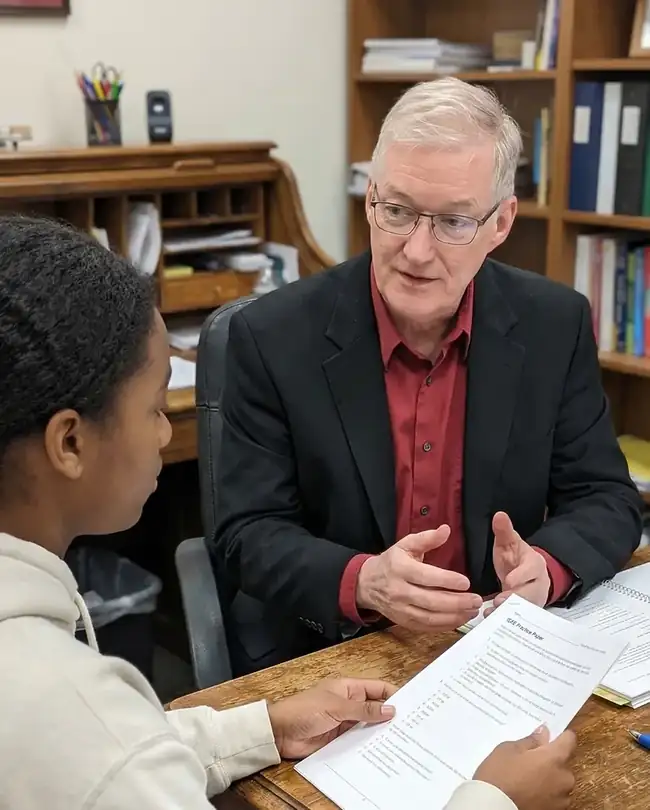
If your child is transitioning from elementary to middle school — or moving between middle school grades — at a competitive independent school, the Middle Level ISEE is typically required as part of the admissions process. This is a pivotal moment in your child's academic journey, and strong ISEE scores can make a meaningful difference.
Schools that commonly require the Middle Level ISEE include The Bishop's School, Francis Parker School, La Jolla Country Day School, Windward School, Harvard-Westlake, Brentwood School, Dalton School, Horace Mann, and many other top independent schools across the country. Some schools accept either the ISEE or SSAT, so it is important to verify requirements for each target school.
The Middle Level ISEE has the same four-section structure as the Upper Level, but the content difficulty is calibrated for students in the 6th–7th grade range. Students at this age are still developing test-taking stamina, so preparation should build both skills and endurance.
Middle Level ISEE Sections & Timing
The Middle Level ISEE has the same structure as the Upper Level but with age-appropriate content. Total testing time is approximately 2 hours and 40 minutes, plus two 10-minute breaks.
| Section | Time | Questions | What It Tests |
|---|---|---|---|
| Verbal Reasoning | 20 minutes | 40 | Synonyms and sentence completion; tests grade-appropriate vocabulary and contextual understanding |
| Quantitative Reasoning | 35 minutes | 37 | Word problems and quantitative comparisons; tests mathematical reasoning and logical thinking |
| Reading Comprehension | 35 minutes | 36 | Fiction and nonfiction passages; tests main idea, supporting details, inference, and vocabulary in context |
| Mathematics Achievement | 40 minutes | 47 | Grade-level math: arithmetic, fractions, decimals, percentages, introductory algebra and geometry |
| Essay (Unscored) | 30 minutes | 1 prompt | Written response sent to schools; not scored but reviewed by admissions |
Key fact: The ISEE has no penalty for wrong answers, so students should answer every question. Dr. Donnelly teaches strategic guessing techniques to maximize points when time is running short.
Section-by-Section Strategies for Middle Level
Dr. Donnelly tailors every strategy to the Middle Level content and your child's individual strengths and growth areas.
Verbal Reasoning
At 30 seconds per question, pacing and vocabulary depth are essential:
- Vocabulary building: Age-appropriate word lists with roots, prefixes, and suffixes to decode unfamiliar words
- Synonym strategies: Elimination techniques when the exact definition is not known
- Sentence completion: Reading for context clues and logical connectors
- Daily practice: Short daily vocabulary exercises to build lasting retention
Quantitative Reasoning
This section emphasizes mathematical thinking over computation:
- Word problem skills: Translating everyday language into mathematical operations
- Quantitative comparisons: Learning to compare two quantities without fully solving
- Estimation: Using rounding and number sense to eliminate wrong answers
- Process of elimination: Systematic techniques for narrowing down options
Reading Comprehension
Passages include both fiction and nonfiction appropriate for grades 6–7:
- Active reading: Underlining key ideas and noting the author's purpose
- Main idea vs. detail: Distinguishing between central themes and supporting information
- Inference practice: Drawing logical conclusions from textual evidence
- Pacing strategies: Managing time across multiple passages without rushing
Mathematics Achievement
Covers core math skills with increasing complexity:
- Fractions, decimals, percentages: Fluent conversion and operations
- Pre-algebra: Solving equations, understanding variables, and order of operations
- Geometry basics: Area, perimeter, angles, and basic coordinate geometry
- Data interpretation: Reading and analyzing charts, tables, and graphs
Why Middle Level ISEE Preparation Is Critical
The transition to 7th or 8th grade at an independent school is one of the most competitive entry points. Many schools have limited openings at these grades, and the applicant pool can be highly qualified. A strong Middle Level ISEE score gives your child a significant advantage.
Students at this age face unique challenges. They may be encountering timed, standardized testing for the first time. The Verbal Reasoning section introduces vocabulary significantly above grade level, and the time pressure can be overwhelming without preparation. Meanwhile, the Mathematics Achievement section may include topics — like basic algebra or geometry concepts — that some students have not yet covered in school.
Dr. Donnelly's approach for Middle Level students is both rigorous and supportive. Sessions are structured to build skills progressively, with regular practice tests to track improvement and build confidence. He teaches not just content but test-taking strategies: how to manage time, how to approach unfamiliar questions, and how to stay calm under pressure.
Middle Level ISEE — Frequently Asked Questions
The Middle Level ISEE is for students currently in grades 6 or 7 who are applying for admission to grades 7 or 8 at independent and private schools. The test content is calibrated to challenge students at this developmental level while identifying high-performing candidates.
The Middle Level ISEE takes approximately 2 hours and 40 minutes (plus two 10-minute breaks). It includes Verbal Reasoning (20 min, 40 questions), Quantitative Reasoning (35 min, 37 questions), Reading Comprehension (35 min, 36 questions), Mathematics Achievement (40 min, 47 questions), and a 30-minute unscored essay.
The Mathematics Achievement section covers arithmetic operations, fractions, decimals, percentages, basic algebraic concepts, introductory geometry (area, perimeter, angles), data interpretation from graphs and tables, and basic probability. The Quantitative Reasoning section tests mathematical thinking through word problems and quantitative comparisons rather than straight computation. Contact Dr. Donnelly for a diagnostic to identify your child's specific areas for improvement.
What ISEE Families Say
“I was about to go with another company when I found Dr. Donnelly. After my son’s intro session, I knew right then and there that his methods were unique and he catered to the individual unlike many big companies, whose methods seem to only help a few people because of how general the strategies are. (I can say this because I used Kaplan twice before.) In ten weeks, he and his strategies took my son’s score from the 66th percentile all the way to the 92nd percentile!! I highly recommend Donnelly! And even if you don’t live nearby, he offers tutoring sessions over Zoom so don’t be shy to reach out to him if you need ISEE or SSAT help!”
“My daughter has worked with Dr. Donnelly for the last three months and it has been wonderful. Dr. Donnelly has been able to focus on her weaknesses and provide enormous insight. In addition, his advice with regards to strategy for the ISEE and SSAT has been invaluable. He is able to engage students and provide support well beyond other tutoring services. He is sincerely committed to student success and offers a personalized service with sound methodology. Within 3 months her scores improved significantly. In addition to all his talents… he is just one of those really smart people that can teach.”