
Upper Level SSAT Tutoring — Grades 8–11
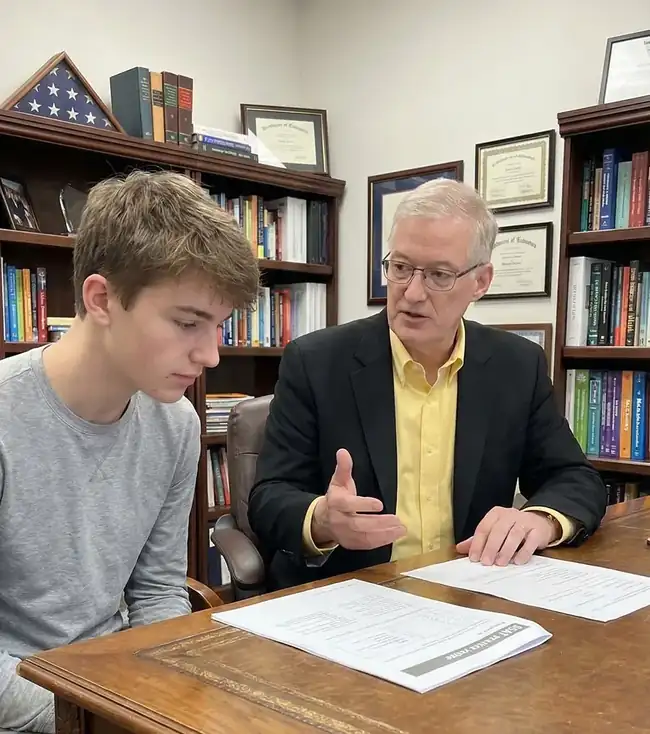
One-on-one preparation for the most challenging SSAT level. Dr. Donnelly helps students master advanced vocabulary, quantitative reasoning, and critical reading to achieve the scores top boarding and day schools expect.
What Is the Upper Level SSAT?
The Upper Level SSAT is taken by students currently in grades 8 through 11 who are applying to independent and boarding schools for grades 9 through 12 (and post-graduate programs). It is the most advanced of the three SSAT levels and features the most demanding vocabulary, the most complex quantitative problems, and the longest reading passages.
Competitive independent schools — including Phillips Andover, Phillips Exeter, Deerfield Academy, Choate Rosemary Hall, and leading day schools nationwide — use Upper Level SSAT scores as a key factor in admissions decisions. Most selective programs expect scores at or above the 90th percentile.
Because the Upper Level SSAT includes a one-quarter-point guessing penalty, students need both content mastery and strategic test-taking skills. Dr. Donnelly's one-on-one tutoring addresses both dimensions, ensuring your child is fully prepared for test day.
Upper Level SSAT Sections & Timing
The Upper Level SSAT consists of six sections administered over approximately 3 hours and 10 minutes, including two 10-minute breaks.
| Section | Questions | Time | Content |
|---|---|---|---|
| Writing Sample | 1 prompt | 25 min | Choose between a personal prompt and a general prompt. Sent to schools but not scored. |
| Quantitative I | 25 | 30 min | Arithmetic, algebra, geometry, data interpretation, number theory. |
| Reading | 40 | 40 min | 7–8 passages (fiction, humanities, science, social studies) with comprehension and inference questions. |
| Verbal | 60 | 30 min | 30 synonyms and 30 analogies testing advanced vocabulary and reasoning. |
| Quantitative II | 25 | 30 min | Additional quantitative reasoning covering the same content domains. |
| Experimental | 16 | 15 min | Unscored questions used for future test development. |
Scoring: Each scored section (Verbal, Quantitative, Reading) receives a scaled score from 500 to 800. The total score ranges from 1500 to 2400. Percentile rankings compare your child to same-grade, same-gender first-time takers on Standard dates from the past three years.
Section-by-Section Strategies
Dr. Donnelly teaches proven strategies tailored to each section of the Upper Level SSAT.
Verbal: Synonyms & Analogies
The Verbal section is the most vocabulary-intensive section on the SSAT, requiring students to answer 60 questions in just 30 minutes. Dr. Donnelly builds vocabulary through contextual learning, root/prefix/suffix analysis, and targeted word lists. For analogies, students learn to identify relationship types (cause-effect, part-whole, degree) and apply a structured elimination process.
Quantitative: Math I & II
The two Quantitative sections test arithmetic, algebra, geometry, and data analysis. Dr. Donnelly focuses on the specific problem types that appear most frequently at the Upper Level, including percent and ratio problems, algebraic equations, coordinate geometry, and probability. Students learn time-saving calculation techniques and when to use estimation versus exact computation.
Reading Comprehension
The Reading section presents 7–8 passages across multiple genres. Dr. Donnelly teaches active reading strategies: previewing questions before reading, annotating key ideas, distinguishing main idea from detail questions, and recognizing inference traps. Students practice under timed conditions to develop the pacing needed for 40 questions in 40 minutes.
Writing Sample
Although the Writing Sample is not scored, it is sent directly to admissions committees. Dr. Donnelly helps students develop a clear, organized response — whether they choose the personal prompt or the general prompt — that demonstrates strong writing ability and critical thinking. A well-written sample can strengthen an application.
Upper Level SSAT FAQ
The most selective boarding schools — including Andover, Exeter, Deerfield, and Choate — typically expect Upper Level SSAT scores at or above the 90th percentile. Some of the most competitive programs look for scores in the 95th percentile or higher. Dr. Donnelly helps students set realistic goals based on their target schools and builds a preparation plan to reach those benchmarks.
Most students benefit from 10 to 16 weeks of focused preparation. Students who start earlier have more time to build vocabulary, strengthen quantitative skills, and take multiple full-length practice tests under realistic conditions. Dr. Donnelly creates a custom timeline during the free consultation based on your child's diagnostic results and application deadlines.
The SSAT deducts one-quarter point for each wrong answer, so random guessing is statistically neutral. However, if your child can eliminate even one answer choice, guessing among the remaining options becomes statistically advantageous. Dr. Donnelly teaches students a systematic elimination strategy so they know exactly when to guess and when to skip a question — a skill that can meaningfully impact their percentile ranking.
What SSAT Families Say
“Dr. Stuart Donnelly gave me the confidence and the tools I needed to succeed and I really could not have done what I did without him. He is extremely knowledgeable on all things SSAT and is beyond patient. He is great at what he does and is super helpful getting his students to the next level. He is also very professional and organized. Would recommend Stuart to anyone who enjoys learning in a 1 on 1 environment and will put in the work he asks for!”
“I highly recommend this service! I had private SSAT lessons with Dr. Donnelly during the Spring. Stuart was very helpful, patient, and flexible, and so knowledgeable! Just got my results back and I couldn’t be happier! I definitely would not have done as well on my exam without Stuart.”