
Primary Level ISEE Tutoring — Grades 2–4 Admissions
The Primary Level ISEE is uniquely designed for young children, with auditory questions, visual elements, and a shorter format. Dr. Donnelly provides gentle, engaging preparation that builds your child's confidence and readiness.
Who Takes the Primary Level ISEE?
The Primary Level ISEE is for children applying to grades 2, 3, or 4 at independent and private schools — typically children ages 5 through 8.
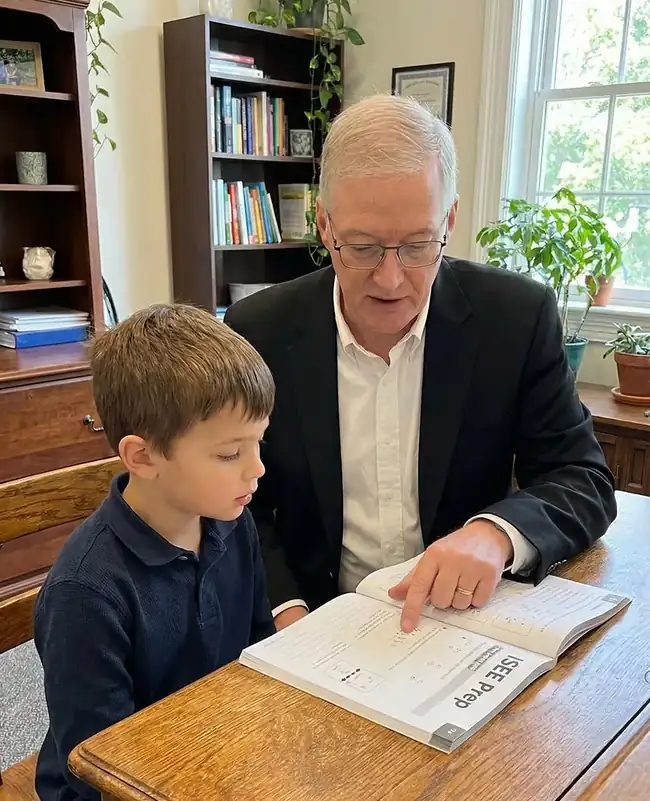
If your child is applying to an independent school for early elementary grades, the Primary Level ISEE may be part of the admissions process. This is a very different test from the other ISEE levels — it is designed specifically for young children who may not yet be fluent readers and who have limited experience with formal testing.
There are actually three separate Primary Level exams: Primary 2 (for entry into grade 2), Primary 3 (for entry into grade 3), and Primary 4 (for entry into grade 4). Each version is calibrated to the developmental stage and academic expectations of that specific grade level. Your child will take only the exam that corresponds to the grade they are seeking to enter.
Schools that use the Primary Level ISEE include many of the country's most respected independent elementary schools. In New York, schools like The Dalton School, Trinity School, Ethical Culture Fieldston School, and Riverdale Country School may require or accept the Primary ISEE. In San Diego, schools like All Saints' Academy and other independent elementary programs may use this assessment.
How the Primary Level ISEE Is Different
The Primary Level ISEE has a fundamentally different format from the other ISEE levels, designed to be accessible and age-appropriate for young children.
Auditory Comprehension
On Primary 2, a few Reading questions are read aloud to the child. These test listening skills and comprehension without requiring independent reading ability — a feature unique to the Primary Level.
Visual & Picture-Based
The test uses pictures, diagrams, and visual cues extensively. Answer choices include images alongside text, making the test accessible to emerging readers.
Shorter Duration
The Primary Level ISEE takes approximately 1 hour — significantly shorter than the 2–3 hours required for higher levels. This respects young children's attention spans and energy levels.
| Section | Format | What It Tests |
|---|---|---|
| Auditory Comprehension (Primary 2 only) | A few questions within the Reading section, read aloud; child selects picture or word answer | Listening comprehension, following directions, understanding spoken language |
| Reading | Short passages with pictures; multiple choice | Emerging literacy, letter recognition, sight words, basic reading comprehension |
| Mathematics | Visual and picture-based questions | Counting, number recognition, basic operations, patterns, shapes, and measurement |
How Dr. Donnelly Works with Young Children
Preparing a 5-, 6-, or 7-year-old for a test requires an entirely different approach than working with an older student. Dr. Donnelly's Primary Level preparation is built around engagement, encouragement, and developmental appropriateness.
Short, Engaging Sessions
- 30–45 minute sessions: Matched to young attention spans, not adult expectations
- Interactive activities: Games, puzzles, stories, and hands-on materials rather than worksheets
- Positive reinforcement: Building confidence through celebration of progress and effort
- No pressure: The goal is familiarity and comfort, not stress and intensity
Building Foundational Skills
- Listening skills: Practicing following multi-step directions and recalling spoken information
- Early reading: Letter sounds, sight words, and reading simple sentences with comprehension
- Number sense: Counting, comparing quantities, recognizing patterns, and basic addition and subtraction
Parent Guidance for Primary Level ISEE
As a parent of a young child facing the ISEE, you naturally have questions and perhaps some anxiety about the process. Here is what Dr. Donnelly wants you to know.
Your child does not need to be a perfect reader. The Primary Level ISEE is specifically designed for children who are still learning to read. On Primary 2, a few Auditory Comprehension questions are read aloud precisely because many test-takers at this age are emergent readers. What matters most is that your child can listen carefully, follow simple directions, and demonstrate age-appropriate reasoning.
Test day should feel normal, not scary. Dr. Donnelly prepares children for what to expect on test day: sitting with other children, listening to an adult read questions, choosing answers by marking bubbles or circling pictures. When a child knows what is coming, the unfamiliar becomes familiar and anxiety drops significantly.
Home activities make a big difference. Dr. Donnelly provides parents with simple, fun activities to practice at home: reading aloud together, playing counting games, doing puzzles, practicing pattern recognition with everyday objects, and encouraging your child to draw or write about their day. These activities build the exact skills the Primary ISEE measures.
Recommended timeline: For Primary Level students, Dr. Donnelly typically recommends 6 to 10 weeks of preparation with one session per week. Consistency and a relaxed pace are more effective than intensity at this age.
Primary Level ISEE — Frequently Asked Questions
The Primary Level ISEE is the youngest level of the Independent School Entrance Examination, designed for children applying to grades 2, 3, or 4 at independent schools. Unlike the higher ISEE levels, it includes auditory comprehension questions (read aloud to the student), uses pictures and visual elements extensively, and is significantly shorter — approximately 1 hour total. There are three separate versions (Primary 2, 3, and 4), each calibrated for the grade the child is entering.
The Primary Level ISEE differs from the Lower, Middle, and Upper Levels in several key ways. It is much shorter (about 1 hour vs. 2–3 hours). On Primary 2, the Reading section includes a few Auditory Comprehension questions that are read aloud. It uses pictures and visual cues throughout. The Reading section tests emerging literacy skills rather than passage-based comprehension. There is no writing sample at the Primary Level. Each section is timed by section (for example, Primary 4 has 30 minutes each for Reading and Mathematics), with one 10-minute break.
Dr. Donnelly takes a gentle, play-based approach with Primary Level students. Sessions are kept short (30–45 minutes) to match young attention spans. Activities are interactive and engaging — using games, stories, puzzles, and visual materials rather than worksheets. The goal is to familiarize the child with the types of questions they will encounter while building foundational skills in listening, early reading, and number sense. Dr. Donnelly also works closely with parents to provide activities for home practice in a low-pressure way. Book a free consultation to learn more.
What ISEE Families Say
“Dr. Donnelly is a wonderful teacher. He is quick to pinpoint weaknesses and, in many cases, turn them into strengths. He always has a structured lesson plan and pertinent homework assignments and puts aside time in the lesson to go over “trouble problems” from the previous lesson. I highly recommend taking a prep course with him. His patience, humor, and kindheartedness make an otherwise uncomfortable standardized test almost enjoyable.”
“Dr. Donnelly tutored my son. My son learned a few steps to help him solve the problems faster and correctly. Every lesson helped my son feel confident. My son constantly talks about how Dr. Donnelly has taught him skills that even transcend beyond the test that he is able to use in his classes at school. Dr. Donnelly was also very good at being able to work around a person’s schedule. I highly recommend him, he is a great tutor. Thank you Dr. Donnelly!”